
This page contains affiliate links. As an Amazon Associate we earn from qualifying purchases.
Incorporating graywater use into your daily life is such a good idea, but sometimes it can seem so complicated. Is there an easy way to use graywater?
Fortunately, there is!
Toilet-sink combo for easy graywater use
A toilet-sink combo is a great water-saving (and space-saving!) device that lets you wash your hands with new fresh water on its way to fill the tank, so you don’t have to turn on the sink. It’s water that’s already on its way to do a job, doing another job first.
Washing up with clean water turns it into graywater, so next time around, you’re using graywater to flush the toilet.
Genius!
These are all over Japan, as you see in the video above.
For your own home, you can buy a whole new toilet from Home Depot if you want, or you can retrofit your existing toilet with a much cheaper alternative, a tank-topper sink attachment fitted to your model.

This is the Sink Twice Original. There are several charts to match your toilet model with the appropriate size sink attachment. This is one example:

Another option is the Sink Again:

Click through to the page and see if your toilet model fits one of the options.
This is one of the best ways to incorporate graywater use into your home. No complicated plumbing, no holes drilled through walls, and usually no permit is needed at all (although it’s worth checking locally).
Perfect!
Is it hygienic?
First things first: the water that comes into the toilet is drinking-quality water. It would be prohibitively expensive to plumb an entire separate municipal delivery system for a second level supply, so the toilets use the same high-quality water you use for cooking, drinking and washing in all your other fixtures.
Second, the water that goes through the toilet starts out inside the tank. It doesn’t reach the bowl until you hit the flush lever. Here’s how a toilet works:
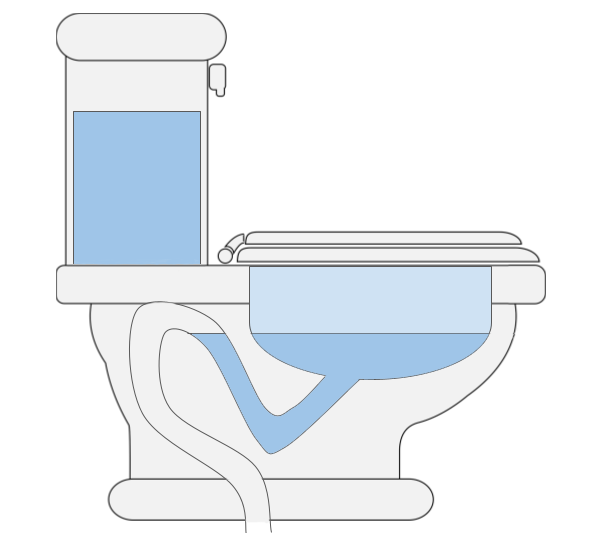
A toilet sitting idle has a small amount of water in the bowl. It stays there because the curved pipe inside bends back up higher than the level in the bowl.
There is also a quantity of water in the tank.
When the flush lever is pulled, water flows down from the tank into the bowl. The weight alone of this falling water pushes the water in the bowl down the pipe and over the top of the curve inside.
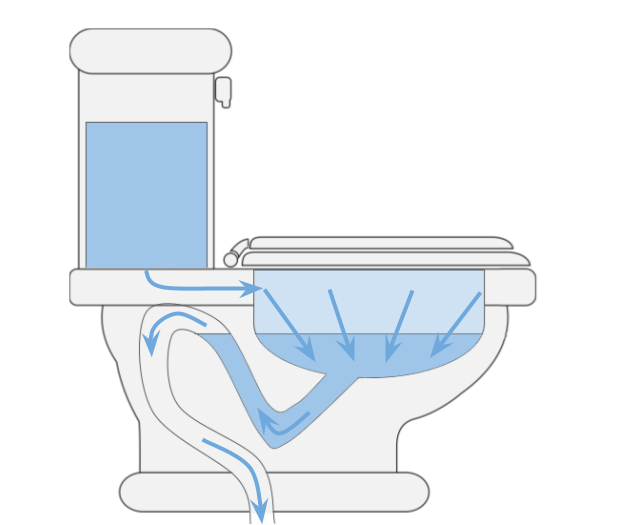
The flow creates a siphon effect that pulls the rest of the water from the bowl along behind it until it’s all drained away.
Meanwhile the flapper valve inside the tank has already closed, and the tank refills once again with fresh clean water.
Fresh clean water incoming
The genius of the tank-topper mechanism is to insert a faucet into the incoming fresh water line before it fills the tank, ensuring your hands are washed by the same quality water you’d be using at the sink.
You don’t even have to turn it on. That water goes that way whether you wash with it or not, so it flows regardless. Because there is now a faucet there, you have the option to wash your hands without running additional water at the sink.
The soapy water that washed your hands goes into the tank, ready for the next flush. It never touches you again, because its next move is to flush out the bowl next time around and go right down the drain pipe.
Is it really graywater?
The essential point of graywater is to get more uses out of the water that passes through your house.
In this case, you wash your hands with clean water. That’s what turns it into graywater, which means “lightly used.” You’re flushing your toilet with graywater.
Best practices must still be followed: Don’t store a tank of soapy hand-wash water for more than 24 hours. If you plan to be away from home longer than that, don’t use the toilet-topper sink shortly before you leave. Let the tank fill up with ordinary clean water.
With this type of device, you don’t have to restrict yourself to graywater-friendly soaps, because it mixes directly into the blackwater line, which must always go to sewage.