
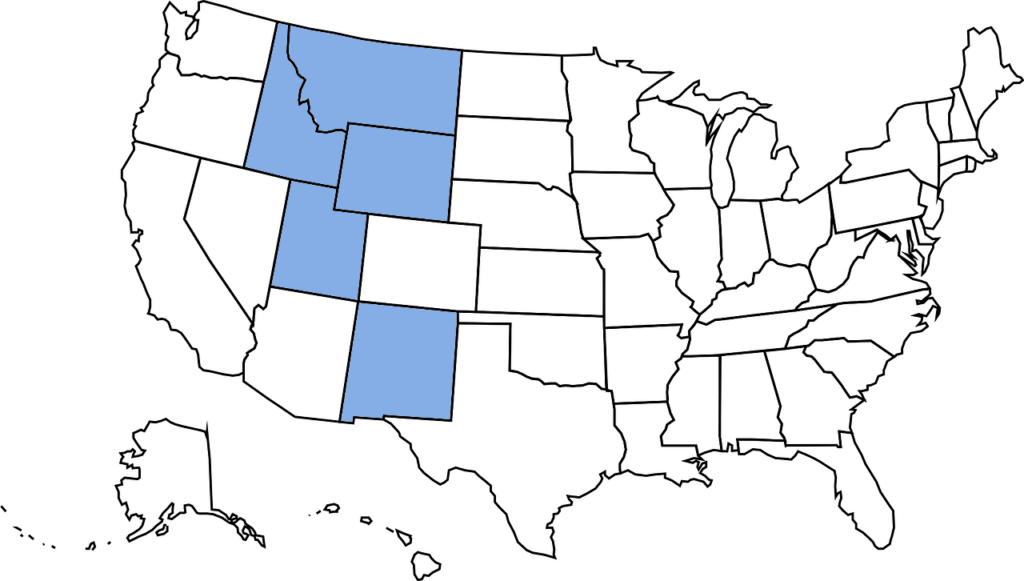
Summaries of more graywater regulations from additional western US states, with links to the sources for your further study.
Utah Graywater Law
Graywater regulations in Utah are extensive and detailed. On the one hand, this may prove troublesome for the small-scale home builder. On the other, it seems apparent that Utah is open to serious institutional graywater use.
Utah recognizes two Tiers: Tier 1 is gravity-fed, and so doesn’t include a surge tank, any pressurized components, or drip line irrigation. This means that laundry to landscape is not in Tier 1.
Tier 2 is anything that includes a surge tank, pre-treatment, drip line irrigation, or pressurized components.
The Utah code goes through the basic standard rules on our Legal page, but adds that graywater cannot be the sole source of water disposal. And if you plan to abandon your system, you have to tell the local authorities 30 days ahead of time.
The state explicitly excludes kitchen sinks from graywater, as well as dishwashers, water softeners, photo lab sinks, and garage floor drains.
All systems require a permit. Further, all system designers must be certified! Tier 1 designers must be certified at a Level 2 as defined by R317-11, and Tier 2 designers must have a Level 3 certification. (This is where the potential headache comes in.)
Maybe they’re being extra careful because you don’t want to mess around in a desert. It’s different in wet climes where rainwater washes your troubles away and the kind of life that breaks down organic wastes is lush and abundant. Perhaps if everyone adhered faithfully to best Soap selection practices, it wouldn’t be such an issue.
While there is a statewide graywater code, the state defers graywater jurisdiction to local health departments. Any local health department can adopt stricter requirements than are in the general rule, can prohibit any particular graywater system if they choose to, and can charge fees. You’ll need to check the regs at every level, wherever you are.
Find the text of the law at the Utah Office of Administrative Rules.
Idaho Graywater Law
Idaho is not fully figured out on the graywater front. On the one hand, they did adopt the IAPMO 2015 Uniform Plumbing Code (UPC), which does have stuff about graywater. But they modified it in confusing ways, and then split administrative authority between two different agencies. They also delegate authority to counties and cities for the final word.
You have to get a different permit for each end of your system. The Division of Building Safety (DBS) manages changes to your plumbing, which you’ll do if you run diversion pipes from any drain. Only Idaho-licensed plumbers can do this work. The Department of Environmental Quality (DEQ) manages all water output areas, which includes mulch beds.
Like in Colorado, there is also the business about Priority Water Rights, where you have to sweat whether someone else can lay claim to your water in some way you’ll be legally liable for. The legal structure for that is Idaho Department of Water Resources Title 42. Likely the DEQ and/or the DBS can help with whether you need to worry about this, but the fact is you have to know about it.
Idaho recognizes graywater as coming from most of the standard sources, explicitly excluding kitchens (see below). Although laundry to landscape does not involve changes to your existing plumbing, the official documents only talk about changes to existing plumbing. It’s not clear where they stand on using laundry water, because here’s the hard part:
Page 295 of the UPC lists showers, bathtubs, lavatories, and laundry as sources of graywater. But if you read carefully the definition of graywater in IDAPA 58.01.16, Wastewater Rules, you’ll find that it excludes water from “cloth washing machines”.
28. Gray Water. Domestic wastewater that does not contain wastewater from toilets, kitchen sinks, dishwashers, cloth washing machines, and water softeners.
Did they really mean to say “clothes washing” machines? Because they really do want to exclude laundry from graywater? Or does “cloth washing” mean something else? What else could it mean?
Maybe they just haven’t heard the word about graywater-friendly soaps out there.
The Idaho Plumbing Authority, a non-government entity, has a helpful page about the problems you’ll face. Note that they speak in generally accepting language about laundry to landscape, despite the definition in IDAPA 58.01.16.
New Mexico Graywater Law
New Mexico is more on top of it when it comes to graywater regulations, having got the clue back in 2003.
A.I. knows about a helpful downloadable PDF from the New Mexico Environment Department, although zero of the links for further info goes anywhere any more.
The summary:
- If you discharge less than 250 gallons of graywater a day, you don’t need a permit.
- Discharge has to be at least 5 feet above the water table.
- You can’t run your system in a floodway.
- Kitchens are excluded.
- Laundry is included.
All pretty common sense, and in keeping with the basic points on our Legal page.
The applicable laws are 20.7.3.809 GRAYWATER SYSTEMS (scan down the page for that entry number) and 20.7.3.810 GRAYWATER DISCHARGES (same place, also scan down the page).
If you’d like a more readable page formatting, the sections are reprinted by Cornell Law School, in Ithaca, New York: part 809 and part 810.
Remember to choose graywater-friendly soaps to keep your soil life healthy.
Wyoming Graywater Law
Fortunately, graywater code in Wyoming is simple and straightforward. Some notable points:
- The limit is 2000 gallons a day.
- Kitchen sinks are included!
- Design it so it won’t freeze in the winter.
- Rather than saying graywater should not be used on food crops other than trees and shrubs, it says food crops should not be harvested for 30 days after application of graywater. Interesting approach.
There’s also a note about requiring odor control. Department of Environmental Quality Air Quality Regulations Chapter 2, Section 11 specifies no odors detectable “at seven dilutions.” So if you’re letting your graywater get rank, better get out your scentometer “as manufactured by the Barnebey-Cheney Company” or the equivalent.
Otherwise, the standard common-sense restrictions and requirements apply.
Searching out the legal text for yourself is a little more jagged, though not overly bad. Cornell Law School in Ithaca, New York has the nicely formatted version here (the related Definitions section is here), but to hear it directly from Wyoming, here’s how:
You can automatically download a PDF here if you’d like. If you’d rather see what you’re getting before it gets into your computer, the search page at rules.wyo.gov requires you to enter 3 bits of info:
First, select from a drop-down menu the Agency Name, which will be Environmental Quality, Dept. of (020). The next drop-down, Program, will be Water Quality. Then write 25 in the Chapter # box, and hit Enter.
You’ll get one result, and when you click it, it shows you one result under that, and when you click that, you’ll see a link to the text of the law.
Scan down to Section 4. Definitions to see the inclusion of kitchen sinks. Scan further to Section 17. Greywater Systems for the rest of the story.
Always use graywater-friendly soaps to keep the microbiology humming.
Montana Graywater Law
Montana is also properly figured out. They follow the standard best practices as on our Legal page, and include the following highlights:
- Permits are required.
- Over 2500 gallons a day must be designed by a professional engineer.
- You must provide soil descriptions according to Appendix B of Department Circular DEQ-4.
- Graywater may not be used to irrigate plants to be consumed by humans. But the next line clarifies that “for purposes of this rule, ‘plants to be consumed by humans’ does not include nut and fruit trees.” Wacky.
- Kitchen sink water may be included, but only where a waste segregation system is in use, which means “dry disposal of toilet waste by a method such as composting, chemical, dehydrating, or incinerator treatment, with a separate disposal method for gray water.”
They even have a note about reusing graywater indoors for toilet flushing. It doesn’t require a permit, as long as the flush toilet goes out to standard wastewater treatment.
See the simple straightforward text on the Montana Secretary of State website.